DNA Sequence
ATCATCTTTGGTGTTTCCTGGGCTGTT
DNA Output
Ile Ile Phe Gly Val Ser Trp Ala Val
Where it is produced?
Cystic fibrosis transmembrane conductance regulator is a protein encoded by the CFTR gene, located on the 7th chromosome. It is mostly produced in epithelial cells, lining different organs like lungs, pancreas, intestines, liver, and bile ducts, reproductive tract. After being synthesized in the cells, the CFTR protein goes to the cell membrane, where it functions as an ion channel.
What's its main role?
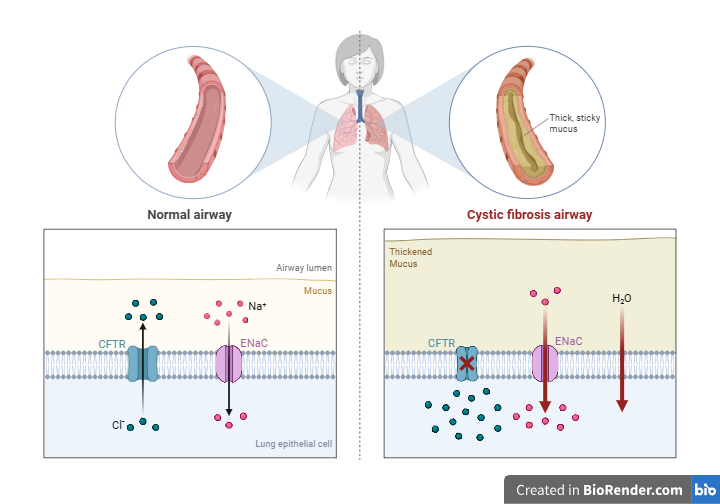
CFTR functions as a chloride ion channel in the epithelial cells’ membrane. It regulates the flow of chloride anions (Cl-) and water across cell membranes. That controls the thickness and hydration of secretion, keeping it always in the right consistency.
General mechanism of action:
ATP is an ion channel rather than an active pump, therefore in a simplified way, its mechanism involves:
- ATP binding
- Change on channel’s form, channel opening
- Cl ions are transported through the channel (usually move outside the cell)
- After Cl- is transported, channel returns to the closed state (ATP hydrolyzed to ADP)
- The ADP molecule detaches after
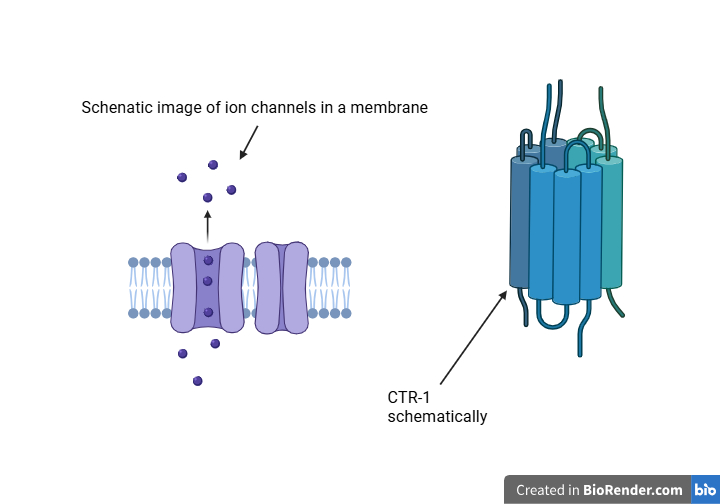
That ion flow influences water and sodium movement through the concentration gradient.
Functions:
- Regulation of Cl ion transport across epithelial cell membranes
- Controls water movement across tissues
- Maintains mucus hydration in the respiratory tract
- Regulated salt concentration in sweat
- Supports digestive processes through fluid secretion in the pancreas and intestines
Structure:
CFTR is a large transmembrane (means goes through the membrane) protein consisting of approximately 1480 amino acids. It is primarily formed from two membrane-spanning domains, which are responsible for forming a channel in the membrane for ions to pass, two nucleotide-binding domains, which bind ATP and regulate the opening and closing of the channel, and a regulatory domain - region controlling channel activity.
Related diseases:
- Cystic fibrosis
- Congenital Bilateral Absence of the Vas Deferens (CBAVD)
Mutations in the CFTR gene lead to the production of a defective, absent CFTR protein. One of the most common mutation is ∆F508, affecting protein folding. Leading to the absence of reduction of chloride ion transport, which also disrupts water movement across the membrane. That makes thick and sticky mucus to be synthesized, which is impossible to clear. Mucus in that case presents as a really favorable bacterial habitat leading to chronic lung infections, cough, lung damage in the respiratory system; in the digestive system, it leads to pancreatic enzyme deficiency, poor nutrient absorption, slow growth in children. These are the most common related consequences.
Some mutations in this gene can lead to male infertility. Abnormal CFTR function disrupts the normal development of the vas deferens, the duct transporting sperm, resulting in infertility. CBAVD is usually considered as mild or atypical form of CFTR-related disorders.